
Saturday, July 7, 2012

Thursday, June 21, 2012
Drinking to remember - a journey into Australian wine
 |
| Skillogalee Vineyard, 1990 |
It is 1990. I am 22 years old. I’m standing
in a small cellar door in the Clare Valley. It’s the first cellar door I have
ever visited. And the glass of wine in my hand has just changed my life.
I have never tasted wine like this. It’s so
much darker, more voluptuous, richer in flavour than any red I’ve tried before.
If this is how good wine can be, I think, I need to try more.
I was an art student from the UK, with an art student's thirst -
and an art student’s budget - on a family holiday in Adelaide. A friend had driven us out to Clare and the Barossa to show us his favourite
wineries. We went to Skillogalee, Mitchell Wines and Sevenhill, then over to St
Hallett, Peter Lehmann and Rockford. For this wine newbie, used to knocking
back cheap plonk, it felt like someone had opened a door to another, far more
delicious and rewarding world and invited me in.
Fast forward to 2012. Now I’m earning a
living writing about wine. And I point to that day in 1990, and the cellar
doors we visited, as the start of the journey that got me here.
So, two decades on, I decided to revisit
those six cellar doors. I have been back to each of them at various times in
the intervening years, of course, for work: vertical tastings, dinners,
festivals. But this time I went to talk. To ask the winemakers about what’s
changed since 1990 - and what hasn’t. About why and how each of them is not
only still there but, it appears, more successful than ever.
I had an appointment, though, before I left
for South Australia. I had to talk with Richard Piper, the family friend who
unwittingly launched a wine-writing career by leading me through the
cellar-door looking glass all those years ago.
 |
| Richard Piper |
It's all Richard's fault ...
Like the good Yorkshireman he is, Richard
has cooked up some black pudding to have with our lunchtime beer. He still
drinks a lot of wine, but beer has become his passion. So I’ve brought some Moo
Brew Imperial Stout to lubricate the conversation. And now we’re drinking to
remember that fateful day in 1990.
“My intention was to get sozzled,” says
Richard, sipping and smiling. “You, on the other hand, were obviously up to
something else because you kept ... disappearing. I remember after the tasting
at Sevenhill winery the rest of us were about to get back into the car but you
were still there in the cellar door, hovering, talking about it. You could clearly glean things I couldn’t.”
But why those
wineries? How did he choose the cellar doors for us to visit?
“I was flying by seat of my pants,” he admits.
“I’d only been in Adelaide three months. But I knew there were certain wineries
where there was care and attention going into everything, where there was a
sense of history and not rushing too fast, not embracing the commercial aspects
and forgetting quality. There was no point taking you to big factories where
there are twelve different products on sale in a metal building and you’re
taken round by a girl in a uniform.
“I think it’s because I’m English - because
we both are. We have that tradition of going round and looking for little pubs
that people don’t know. That sense of exploration, of going off the beaten
track and finding odd places. That’s why cellar doors like Rockford appealed.
It looked cozy.”
 |
| Robert O'Callaghan |
Rockford: connecting people
“Come on through the rabbit warren,” says
Robert O’Callaghan as he leads me past the cellar door and into his small
office. His loyal band of staff are setting up for one of Rockford’s regular,
legendary lunches outside - a lunch that, regrettably, I’m going to have to
miss - so we sit at a big old desk in the cool and talk about the last twenty
years. And it soon becomes clear that here, not much has changed.
“Cellar door’s exactly the same as it was in
1990,” says Robert. “In fact, you were a bit stiffed that you didn’t get to
stay for dinner then either. Just after I opened (in 1984) my marriage had gone
down the gurgler. So the cellar door became my social life. If there were any
people hanging around at 5 or 6 o’clock they usually ended up staying for
something to eat and drink.”
It wasn’t always quite that social. “Oh, I had
days when no-one came in,” says Robert. “But I also had an absolute commitment
to not selling through a distributor or retail chains, so I had to stick it out.
In the end it was the right decision, but it took ten years to get enough core
customers to make it work. And we’re still primarily a cellar door business. Only
five per cent export, still no distributor.”
When Robert set up Rockford in the
mid-1980s, the wine industry was, to use his own phrase, on its arse. Almost
nobody was getting into the game. Most wanted to get out.
“I was against the trend, I gotta say,” he
says. “Talk was that the whole cellar door thing was finished, because of the
busloads of drunks we were getting at the time. But I didn’t see it that way. I
always saw cellar door as a critical opportunity to connect the people who
drank the wine with the people who make the wine. Still see it that way.”
Ducking into Skillogalee
Dave and Diana Palmer had only owned the
Skillogalee vineyard for a year when I visited in 1990, but the place had been
going since the mid-70s, so the tiny cellar-door had a lovely lived-in
atmosphere. It still does. There’s a timelessness here. In 1990 I took a
picture from the car park looking up the hill. Two decades on, I take another
picture from almost the same spot. They could have been shot on the same day.
 |
| Skillogalee Vineyard, 2010 |
 |
| Dave Palmer |
Yes, there was a time, in the late 90s,
early 2000s, when things were booming. The Palmers even bought the vineyard
next door. Doubled production.
“But at that point the shock of oversupply
in the industry hit us”, says Dave. “Suddenly, we couldn’t sell all our wine.
So we had to get out there and sell the story. And, importantly, we kept the
restaurant going. We knew that people who come to Skillogalee go on to tell the
story for us - about ducking their head into cellar door, and about the nice
garden.”
“We’ve worked very hard to bring it all
back to a sense of place,” says Diana Palmer. “I love it when we come across
people in London who tell us they’ve eaten on our verandah.”
Poetry and bullshit at Mitchell Wines
The biggest change at Mitchells in the last
twenty years has been in the vineyard. Since the middle of the last decade,
Andrew and Jane Mitchell have converted their estate to biodynamic farming. They’re
particularly proud of the small herd of Highland cattle that provides manure
for their compost and biodynamic preparations.
 |
| Andrew Mitchell and his cows |
“The first irrigation didn’t appear in
Clare until 1970,” Andrew reminds me. “Before that, everybody managed to make good
wine without it. Some of the vineyards at Sevenhill were planted in the 1860s
and they’re still there.”
“In many ways,” says Jane, “we’re basically
returning to doing things the way Andrew’s father did back in the 1960s.”
Andrew agrees, pointing out that while a
lot of young winemakers make a big deal these days about fermenting with wild
yeasts, for example, it’s really just a case of back to the future: “I have a
lovely memory of talking to Roly Birks (legendary winemaker at Wendouree) who
said it wasn’t until the 1940s that he started ‘putting the ferment in’ - and
even then that meant going to Leasingham winery to get a bucket from a ferment
and seed his tanks with it.”
And then he quotes from the TS Eliot poem, Little Gidding: “‘We shall not cease
from exploration, and the end of all our exploring will be to arrive where we
started and know the place for the first time’.”
 |
| Brother John |
“Welcome to Sevenhill,” says Brother John
May, smiling his impish smile and shaking my hand.
“Hello Brother John, are you well?” I ask,
a little concerned by the two large skin-tumor scars on the top of head.
“Oh yes,” eyes glinting, glancing
heavenward. “Well, except for being de-horned...”
 |
| Mass at Sevenhill |
Brother John explains that there is a
spiritual significance to Sevenhill that people instinctively feel when they
turn into the driveway. As well as the visual impact of the church, the vines
and the gardens - “We have all the scripture references,” he says. “We have
the vine and the branches. We have green all the year
round” - there’s the heritage of having 41 brothers buried in the crypt, and
the fact that Brother John is leading the same life as those men were, for the same reason - “And,” he says, smiling, “for the same pay!”
“It’s a tranquil place,” says Brother John.
“It’s not a commercial place. It’s a manifestation of the words of the mass:
‘The fruit of the vine and the work of human hands’. It’s not something you can
experience on Facebook.”
Smelling the vintage at St Hallett
The cellar door at St Hallett in the
Barossa also has to be experienced first-hand - preferably at vintage time.
Recently-installed sliding windows in one corner of the room look over an old
but still working fermenting vat: when it’s full of purple-foaming shiraz
grapes, visitors can see, smell and even taste the wine being made.
“For me it’s really important that people
can get close to what we do and take back memories,” says longtime winemaker
Stuart Blackwell. “I remember coming up to the Barossa in the mid-60s, going to
Grant Burge’s Wilsford winery and smelling the vintage and that was it for me,
career decided. The smell of ferment in the air gets you every time.”
 |
| Stuart Blackwell |
“A lot of good things can happen by having
a big brother,” he says. “Lion leave us pretty much alone in the winemaking,
but they have opened markets up for us, and helped us weather the storm of the
last few years.”
The storm, of course, is far from over. But
it has also forced St Hallett to focus on the important, fundamental things -
like introducing cellar door visitors to the smell of vintage.
“We’ve asked ourselves: what do we believe
in?” says Stuart. “Does [our wine] have a place? And we believe absolutely in
Eden Valley riesling, in Barossa semillon - even though we can’t sell it! - and
shiraz. You’ve got to have a reason for being.”
The Lehmanns having fun
It’s a hot afternoon. Peter Lehmann is
perched at the end of the big old table in his big old kitchen, watching
cricket on the telly. A fan drones. Margaret Lehmann drops ice cubes into
glasses of water for us all. Peter lights another cigarette as Australia takes
another wicket.
From his start at Yalumba in the 1940s, Peter
Lehmann has seen the industry go through many cycles. It was the downturn of
the 1970s that inspired him to leave the comfort of a big company and set up
his own label. And despite the fact that his eponymous company grew during the
1990s to such an extent that it became a prime takeover target (it is now part
of the Swiss Hess Family wine group) he and Margaret are excited by the
proliferation of new, vibrant winemakers setting up shop across the region and
the industry - winemakers like their sons, David and Phil.
“For visitors to the Barossa, the small
winemakers have so much more interest than the big places,” says Peter. “In the
long term I’m still pretty optimistic about the future. I see no reason to
discourage either of our younger sons to give up their winemaking pursuits.
Anything agricultural is a pendulum.”
Margaret’s clearly energized by her sons’
decision to continue winemaking. She’s describing David’s happily chaotic approach
to vintage - “He’ll have 35
ferments going and there he is dancing around like a cat on hot bricks
- I love it!” - when, right on cue, he walks into the
kitchen clutching a cold bottle of semillon.
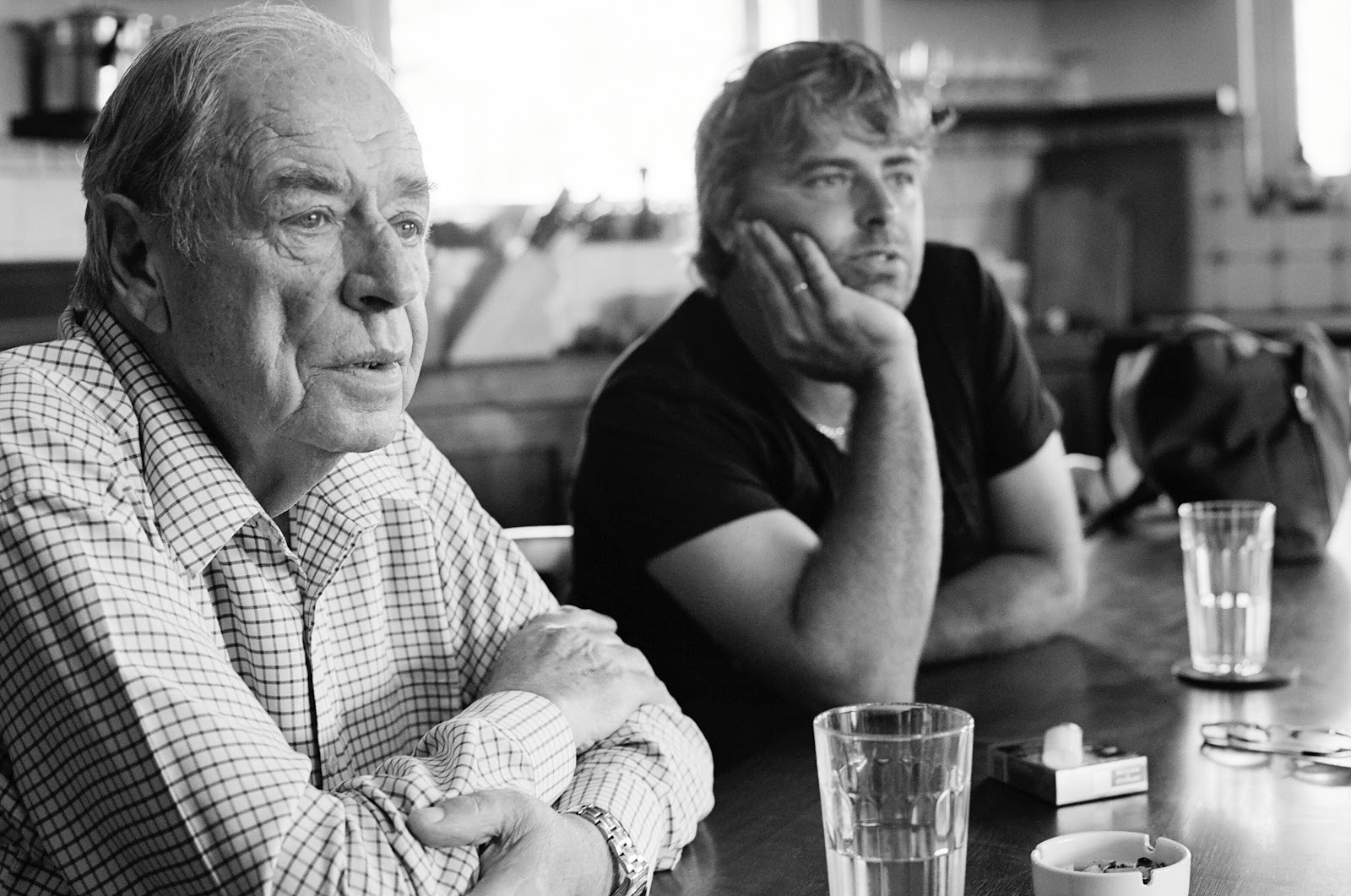 |
| Peter Lehmann (l) David Franz Lehmann (r) |
Glasses are found. The wine is poured. And soon David Franz Lehmann is talking about the last twenty years. According to him, somewhere along the line, in the late 90s, early 2000s, the wine industry became too serious. Too much money in it.
“But back in your day, dad,” he says,
looking across at Peter, smiling as he lights up another B&H, “you guys had
a lot of fun. Thankfully, some of
that’s come back: come to the Barossa, go down to McLaren Vale, over to the
Yarra Valley - there’s idiots pumping out great wine everywhere and having a
lot of fun.”
(A shorter version of this story appeared
in Australian Gourmet Traveller WINE Magazine, April/May 2012. If anyone's interested, I took the picture of Skillogalee in 1990 on an Olympus OM10 and used the same lens to take all the other photographs in 2010 using an Olympus OM1 body. Yes, Virginia, these photographs were shot on film. Old skool.)
Tuesday, March 27, 2012
Tasting in Technicolor

A few years ago I started tasting wine -
and recording my impressions - in a different way. I haven’t shared my new
approach to wine evaluation with too many people because while it makes perfect
sense to me it could appear odd to anybody used to tasting and describing wine
conventionally. But a remarkable new book - Neurogastronomy,
how the brain creates flavour and why it matters, by neurobiologist Gordon
M Shepherd ($40, Colombia University Press) - shows there may be method in my madness after all.
I was taught to taste by compartmentalizing
my experience: first smell the wine’s aromas intently, then take a sip and roll
it around your tastebuds and, after you’ve spat or swallowed, think about the
aftertaste. This stage-by-stage process is employed right through to
professional Australian wine shows where scoring out of 20 is traditionally
broken down into 3 points for colour, 7 for aroma and 10 for taste, body, etc.
But it began to dawn on me that evaluating
wine like this doesn’t reflect the holistic, seamless way that real people
experience wine. So I started skipping the initial smell stage and just putting
the wine straight in my mouth. And I discovered that I could capture a more
complete impression of the wine by doing this because I was experiencing the
tactile sensations of the liquid - the tastes and temperature and touch of the
wine on my tongue - at the same time as smelling it retronasally, via the passage at the back of the throat that leads
up to the olfactory receptors in the nasal cavity.
Now, in Neurogastronomy,
Gordon Shepherd corroborates my approach by describing in great detail how it
is this combined sensation of taste
and smell that leads to the rich and vivid perception of flavour. Brain scans
have shown that while taste stimulates one part of the cortex and smell
another, simultaneous stimulus elicits a response in other areas of the brain
as well.
Not only that, but Shepherd also describes
how the flavour system works by using visual language. The olfactory mechanism
located at the roof of your nasal cavity, he says, forms unique ‘flavour
images’ from the thousands of molecules released by the food or drink in your
mouth, much as your brain forms a unique, whole, easily recognisable picture of
a human face from the many visual signals it receives.
For me, this is a revelation. You see, as
well as using words to describe various qualities in a wine (e.g.: “this
Barossa shiraz is jam-packed with dense dark fruit and robust tannic grip”) a
few years ago I also started drawing little pictures to represent my experience of tasting a wine: so that
same Barossa shiraz, say, might be represented by an opaque black blob
surrounded by a sturdy rectangular frame.
As I say, I haven’t made too much of a song
and dance about this because, well, at times I’ve felt like a bit of a
pretentious wanker. But now I’ve read Neurogastronomy,
I don’t feel so foolish at all.
(This is a version of an article that first
appeared in The Weekend Australian on March 17, 2012. The subject of taste, flavour and neurogastronomy was also covered by Radio National's First Bite program on March 24, 2012 - listen here)
Wednesday, February 15, 2012
Wine Australia ditches tasting panel - common sense prevails
Well, well, well. Wine
Australia, the industry’s regulatory body, has scrapped the controversial
export tasting panel.
 |
| Full cloud alert: one of these things is not like the others ... |
I wrote about the tasting approval process in
The Weekend Australian last year. Since 1929, before being allowed to leave our
shores, every wine destined for export been assessed by a panel of wine
professionals to ensure it is ‘sound and merchantable’ and does not ‘bring
Australia’s reputation into disrepute.
I - and other journalists - have long
pointed out the problems at the heart of this process. If a wine has already
received an export order from a customer overseas, for example, surely that
alone makes it ‘merchantable’? And while many of the wines that were being
rejected for being faulty (i.e., ‘unsound’), they are exactly the kinds of
funky, quirky, idiosyncratic styles that could actually enhance Australia’s image overseas - an image founded on
technically sound (there’s that word again) but ultimately bland wines.
This issue enjoyed a burst of international
attention in August when winemaker Gary Mills of Jamsheed in the Yarra Valley
hit Twitter to complain about how he had had a wine rejected by the panel -
despite the fact that it had already been selected by a Master of Wine to be
served at a special dinner in Japan, and was receiving rave reviews back home.
I tracked down a bottle - it was a 2011
cabernet franc - and tried it. Yes, it was hardly what you’d call squeaky clean
- it was a bit cloudy and a but sharp - but it was super-juicy, fun,
refreshing, and very much in the ‘natural’ style so beloved of trendy wine bars
and indie retailers (indeed, it was floor-stacked inside the front door of the
indie retailer I bought it from). A few re-Tweets later and suddenly
international journalists were taking an interest, joining the chorus of
disapproval for the approval process.
Soon, rumours started circulating (on
Twitter of course) that Wine Australia was seriously thinking of disbanding the
export tasting panel. And now, a few months later, this has indeed come to
pass.
So what happened? Why the change of heart?
The power of the press? A triumph for Twitter? Or simply a case of good
old-fashioned common sense prevailing?
Probably a little of all of the above.
Certainly the new approach is more sensible and realistic than the old
approach: rather than mandatory pre-export tasting for all wines, the existing
system of compliance audits (which includes checking winery records and labels)
will be expanded to include analysis and taste-tests.
It would be great if this could be
supported by some in-depth wine training for the auditors (it would have been
good if this could have been offered to the old tasting inspectors, too). Anybody
assessing whether a wine is ‘sound and merchantable’ need to be exposed to the
incredible diversity of styles out there: from big, black, overoaked,
over-alcholic shiraz to cloudy, orange, amphora-fermented sauvignon blanc,
almost anything goes out there in the modern wine scene.
As Wine Australia chief executive Andrew
Cheesman himself said when announcing the overhaul: ‘The market place and
consumers should be the arbiter of wine quality.’
(a version of this article first appeared
in The Weekend Australian A Plus on 11 Feb 2012)
Monday, January 16, 2012
What’s in your wine?
(A version of this article first appeared in The Weekend Australian A Plus section on 31 December 2011)
Poor old wine. As we slosh our way through
the festive season, our favourite Coonawarra cabernet is no doubt copping more
than its fair share of blame for the headaches and hangovers we are currently
enduring.
 |
| photo: Adrian Lander |
Some people identify the wine’s alcohol -
specifically the alcohol in that fifth glass of Coonawarra cabernet - as the
cause of our predicament. But many accuse the ‘other stuff’
in wine of making us feel bad: it must have been the preservatives/the
additives/the sulphur dioxide - that’s
why my head hurts this morning.
There is a widespread view out there among
the wine-drinking community that the additives and processing aids routinely
used in wine production have a detrimental effect on the drinker. There is also
growing anxiety about what exactly is being added to Australian wine in the
first place, and the detrimental effect this is having on wine’s image.
Consumer concern couldn’t have been
expressed any more alarmingly than in a recent news headline in The Australian: ‘Nod
for laxative chemical to be used in winemaking’. The chemical in question is
sodium carboxymethylcellulose, or CMC, a thickener, already used in a huge
range of products from toothpaste to ice cream (and, yes, laxatives) which has also just been approved as a wine additive by Food Standards Australia New Zealand.
Despite wine industry assurances that CMC is harmless, the headline underlines that niggling
worry; I mean, sodium carboxymethylcellulose ... it just sounds so unnatural.
One of the reasons people are worried about
what’s in their wine is the fact that very little information about what’s in
their wine appears on the label. Other than listing mandatory information such
as alcohol content and the presence or even possible presence of
widely-recognised allergens - sulphur dioxide (added as a preservative) and
milk, eggs or nuts (used as clarifying agents) - the winemaker is not required
to declare any of the dozens of approved additives or processing aids allowed
by FSANZ.
A few months ago, when I wrote about the
possible approval of CMC and whether such additives should be listed on wine
labels, I asked readers for feedback. I was inundated with
emails: it appears the vast majority of you would indeed like to see
ingredients labelling on wine.
Two areas of concern emerged: health issues
associated with drinking wine ‘laden’ with chemicals, and the perception of
winemaking as an increasingly industrialized process.
“There is no doubt in my mind that the
amount of chemicals in wine impacts on my health,” said one reader, echoing
many. “There are times I can drink three glasses of wine from a bottle and wake
up fine, and then other nights when I have three from another wine I wake up
with a splitting headache. I feel very strongly that the Government has been
criminally negligent in not legislating to have every single additive displayed
on the label of all food [because] wine is a food as far as I am concerned - it
goes into my digestive system!”
Creina Stockley, health and regulatory information
manager for the Australian Wine Research Institute, hears similar concerns all
the time. She points out that, while a few people are genuinely allergic to
some wine additives (primarily sulphur dioxide), by far the primary cause of
adverse reactions is - ahem - the alcohol, present in far higher concentration
than any other component in wine. In other words, she says, it is highly unlikely
that processing aids or additives are the wicked culprits they’re often made
out to be.
But health isn’t the only thing you’re
concerned about. The perceived over-manipulation of wine also threatens its
image as a natural product.
One veteran winemaker wrote in to voice his
contempt at the approval of CMC as a wine additive. “The search for more and
more processing aids [like this] is driven by the commercial need to make an
acceptable wine from fruit that has been either grown in an inappropriate
climate, harvested too early or too late or converted to wine by incompetent
winemaking,” he harrumphed. “Grapes harvested at physiological ripeness and
handled by a competent winemaker should not need that many additives or
enhancements to ‘improve’ quality. The addition of [CMC to the list] will
further strengthen the perception (particularly overseas) that Australian wine
is too ‘manufactured’.”
Many readers agreed, advocating labeling.
“I think it’s only fair that we wine drinkers should be able to easily tell
which winemakers are brave enough to let the grapes speak for themselves,
rather than manipulate the juice to fit their ideal through the use of a
cocktail of chemicals,” wrote one. “I travel to many wine producing regions,” wrote
another “and if a winery promoted that it was limiting what additives it used I
would make sure I visited there before less additive-friendly wineries”.
Katrina Birchmeier of Hobart’s Garagistes
restaurant, which prides itself on its list of natural, additive-free wine, is
adamant: “I definitely think that wines should be required to state on their
labels all the ingredients used in the wine making process. I'm sure it would
cause great uproar across the Australian winemaking industry. But if producers
are willing to put this stuff into their wine (and drink it themselves), then
why should they be scared to put it on a label? Consumers need to be able to
make an informed choice.”
Some readers, however, felt that full
disclosure is not the best way to address consumer concerns - and could even
make matters worse.
“No, wine makers should not list all the ingredients and
processing aids,” wrote one reader, an industrial chemist. “Take diammonium
phosphate. That sounds like a ‘chemical’, so it must be bad for you, right? In
fact it’s a yeast nutrient and there’s none left in the wine by the end of the
fermentation process. I'm sure that the more these additives are referred to in
'chemical' terms, the more the public will view the product as synthetic rather
than natural. To reduce a wine to a list of its component ingredients is to
reduce it to a science, not to elevate the art. As some great salesman once
said, ‘Sell the sizzle, not the steak.’”
Winemaker Frank van de Loo from Mount
Majura vineyard in Canberra has a similar if slightly different view: while he
doesn’t think ingredients labeling is necessary, he’s all for transparency -
and has even done something about it.
“I think if we winemakers are going to
bandy big chemical names about,” he says, “we need to help people know what
they are and what they are there for.” So he has set up What’s In Wine, a blog that acts as a
“plain-English (and slightly opinionated) guide” to wine additives and
processing aids.
If you are at all concerned about this topic,
or if you want to learn exactly what additives are available to winemakers, van
de Loo’s blog is worth reading, as is the list of health-related FAQs on the
Australian Wine Research Institute’s web site. Neither will put you off your
wine entirely - but they might inspire you to seek out wines that haven’t been
buggered-around with too much.
WHAT’S IN MY WINE? YOUR QUESTIONS ANSWERED
Why do some wines cause me problems while I
have absolutely no problem with others?
“Unfortunately,” says Creina Stockley,
“there is no satisfactory answer to this question. There are very few actual
allergens in wine, the main one being sulphur dioxide (and other sulphites used
as preservatives). But the majority of people aren’t allergic to sulphites;
there’s not even a huge number of people who are intolerant.” So we can rule
out sulphites as the bad guy? Well, yes - and besides, she says, wine contains
relatively low levels of sulphites: you’ll find more in supermarket sausages or
burgers, and much more - ten times the amount - in dried apricots or sliced
apple. Stockley suggests that different wines affecting people in different
ways is more likely to be caused by compounds derived from the grapes
themselves. “There are hundreds of naturally occurring compounds in wine,” she
says. “It’s very hard to pinpoint how they interact - and how the food you’re
eating reacts with them. And there are so many other factors to take into
account: as you get older your body handles the alcohol less well; for women,
hormones play an enormous part; it could even come down to lack of sleep: how
tired you are when you drink the wine.”
I can drink European wine without any
side-effects but Australian wine gives me a headache. Do European wines contain
fewer chemicals?
No. Contrary to popular opinion, it’s just
not true that European wines contain fewer additives than their Australian
counterparts. “It’s a myth,” confirms Stockley. “Australia’s standards are
aligned with European standards: they can add the same things we can.” In other
words, cheap industrial wine is cheap industrial wine, regardless of where it’s
from. Indeed, says Stockley, the recent approval by FSANZ of carboxymethylcellulose
was in part to bring our standards in line with the rest of the world: CMC is
already an allowed wine additive in many other countries. Instead, Stockley
suspects people’s different experiences drinking Australian and European wines
may again be down to varying natural constituents in the wine derived from
different soils and the use of different grape varieties.
If a wine is labeled ‘organic’ does that
mean it contains no added chemicals?
Not necessarily. Just fewer added chemicals. Australian organic certifying organisations do
allow some additives such as sulphur dioxide but in lower doses than in
‘conventional’ winemaking: according to the AWRI web site, “the amount of
sulphur dioxide which can be added to ‘organic’ wines is approximately 50 per
cent less than that which can be added to ‘non-organic’ wines.” And, to be
fair, conscientious, quality-minded ‘conventional’ wine producers also try to
limit the additions to a fraction of what’s allowed by FSANZ.
So ‘organic wines’ aren’t the same as
‘preservative-free’ wines?
No. You can find many organic wines that do
contain low levels of sulphites - and you can find wines labelled
‘preservative-free’ that are made from conventionally-grown grapes. However, in
my experience the best preservative-free wines are made by certified organic
producers: Botobolar and Lowe in Mudgee; Temple Bruer in Langhorne Creek and
Battle of Bosworth in McLaren Vale.
Subscribe to:
Posts (Atom)